Introduction
In my recent project at The Masen Group, I focused on refining predictive models for call volume at 911 call centers. This effort was aimed at helping emergency response teams optimize staffing and resource management, crucial for improving response times and operational efficiency.
The Challenge
The challenge was to accurately forecast call volumes to aid in resource allocation and staffing. This required analyzing historical data, recognizing patterns, and predicting future demands.
The goal was to develop a robust model that could handle the variability and unpredictability of emergency call patterns, providing reliable forecasts even during peak times and unexpected spikes.
Model Training
The project utilized historical call data from Mineral County, which included timestamps, weather conditions, and holiday occurrences. Notably, we excluded data from the year 2020 to avoid the anomalies caused by the COVID-19 pandemic, which introduced noise into the call data.
By focusing on data from January 1, 2021, onwards, we ensured a more stable and representative dataset for model training.
Data Preprocessing and Feature Engineering
Here’s a brief overview of the preprocessing steps:
- Data Cleaning: Duplicate entries were removed to ensure the uniqueness of the dataset.
- Feature Engineering: Time-based features such as hour, day of the week, month, and year were extracted to enrich the model’s input.
- Categorization: Variables like precipitation and temperature were categorized into ‘No’, ‘Low’, ‘Moderate’, and ‘High’ to simplify the model’s understanding of weather conditions affecting call volumes.
Model Training
The core of our predictive model was built using LSTM (Long Short-Term Memory) networks, ideal for handling time-series data due to their ability to capture long-term dependencies.
By leveraging a two-layer LSTM network within TensorFlow, we could effectively train our model on historical call volume data, learning intricate patterns and anomalies.
Model Architecture:
- The first LSTM layer with 50 units returned sequences, preparing the data for further temporal abstraction.
- A second LSTM layer with 50 units processed these sequences, fully focusing on temporal dependencies without returning sequences.
- This was followed by a dense layer of 25 units and a final output layer for predicting call volumes.
Results and Evaluation
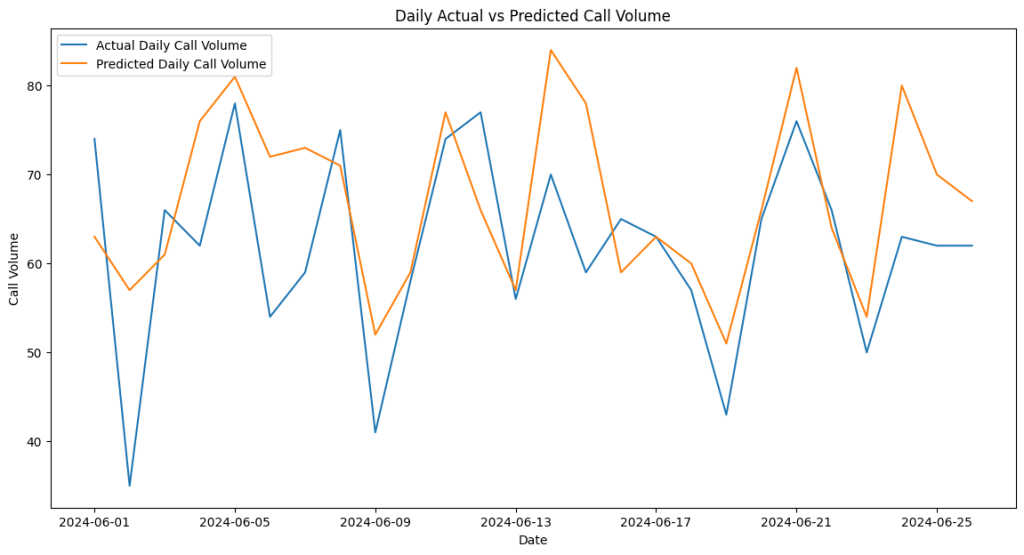
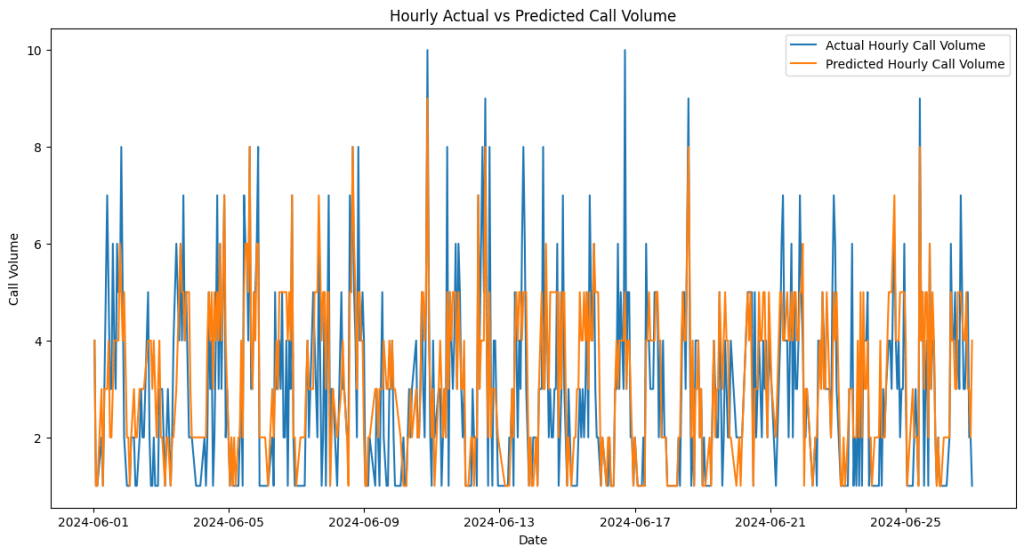
The LSTM model’s performance was evaluated based on its ability to predict hourly and daily call volumes:
- Hourly Predictions: Displayed noticeable alignment with actual call volumes, showcasing the model’s capability to handle intra-day fluctuations effectively.
- Daily Aggregations: Further validated the model’s effectiveness, with predictions closely mirroring actual daily volumes.
Conclusion
The LSTM model demonstrated promising results. This project not only enhanced our predictive capabilities but also set a benchmark for future improvements in emergency call center operations. With ongoing adjustments and refinements, we aim to further reduce prediction errors and adapt to evolving call patterns.
This deep dive into LSTM model training for call volume prediction underscores our commitment to leveraging cutting-edge AI and machine learning techniques to drive operational improvements and support critical emergency response functions.
 Mengxi Li
Leave a comment